Lightning, one of nature's most
powerful forces, can cause a great deal
of damage, particularly in a farm
environment. A lightning strike can start
fires in buildings, damage electrical
equipment, and electrocute humans and
livestock. Losses from lightning can be
very costly. Replacing buildings,
equipment, or livestock disrupts farm
operations and incurs considerable
expense, and of course a human life
cannot be replaced. Fortunately, most
losses caused by lightning strikes can be
prevented by installing proper lightning
protection systems.
Positive and negative electrical charges
exist throughout nature. Under normal
conditions, these charges are paired up
and neutral, exhibiting no net electrical
charge. The charges, however, have the
ability to move about and separate.
Strong air currents, moist air, and
extreme temperature differences can all
disrupt the natural balance of these
charges.
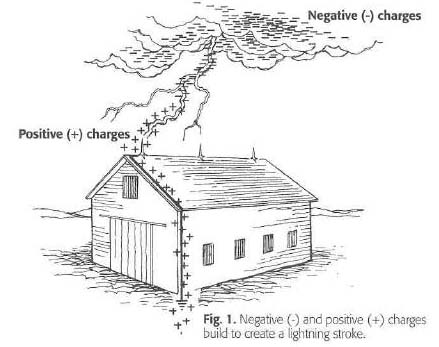
Lightning occurs when the imbalance
between charges becomes too great.
Certain weather conditions can cause an
abundance of negative charges to gather on the bottom of
clouds, while positive charges
accumulate on buildings, trees, or any
objects that project above the ground.
When the negative and positive charges
build to high enough levels, a streamer of
negative charges moves erratically
toward the earth. At the same time, a
short leader of positive charges may
move a short distance up into the air.
When the two charges meet, the
downward moving streamer completes
the grounding path as the positive
charges instantaneously move back up
the path to the clouds (see fig. 1). The
resulting flash is lightning. A lightning "stroke" happens very quickly and
contains a great deal of electrical energy.
Lone trees and isolated buildings,
which are closer to the clouds than their
surroundings, tend to concentrate
positive charges. Consequently, they are
frequently the objects of lightning strikes.
High objects actually intercept lightning
strikes from other nearby objects. That is
why it Is particularly important to take
precautionary measures to protect farm
buildings from the damage lightning
strikes can produce.
Lightning can enter a building in one of
four ways:
- It can strike a metal object on the
roof.
- It can strike a building directly (called
a direct strike).
- It can strike a tree or silo near the
building and jump to the building.
This occurs when the building
provides an easier path to ground.
- It can strike a power line or a wire
fence and follow the line or fence to
the building.
A properly designed lightning
protection system safeguards vulnerable
structures, equipment, and trees by
providing an easy path to a ground,
which harmlessly dispels the electrical
charges. Protection should also be
provided for objects located where a lightning strike's current might
sideflash, such as electrical wires or
metal devices on building roofs.
Depending on their location, some
silos should be tied into a building's
lightning protection system. It is also
possible to extend protection to trees
situated near farm structures or that offer
cover for livestock. Detailed
specifications for these systems can be
found in the codes and standards cited
later in this fact sheet.
Installing lightning protection systems is
not a do-it-yourself job. To ensure that a
lightning protection system is safe and
effective, it should be designed and
installed by trained professionals.
Certain codes and standards must be
followed when lightning protection
systems are installed. Standards and
sources are listed below:
LPI-175: The lightning protection code,
published by the Lightning Protection
Institute.
NFPA 78: National Fire Protection
Association Lightning Protection
Code.
ASAE EP381: American Society of
Agricultural Engineers, Engineering
Practice.
96AUL: Requirements for Master Label
for Lightning Protection, developed by
Underwriters' Laboratories.
The Lightning Protection Institute will
certify a lightning protection system that
meets all its requirements. To retain
certification, the system must undergo
regular maintenance and be inspected
annually. Maintenance of any lightning
protection system is vital to make sure
the system will work when it is needed.
Weather conditions, such as high winds,
can damage components of a lightning
protection system. Building additions and
re-roofing can also affect a system's
performance.
Main Components
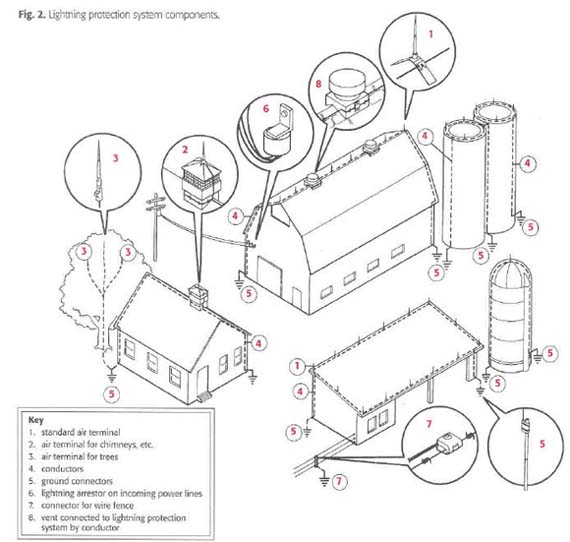
The major components of a building's
lightning protection system are air
terminals, conductors, and ground
electrodes (see fig. 2).
Air terminals are more commonly
known as lightning rods. They are placed
at intervals on the roof and on any high
points projecting from the roof. Lightning
rods are made of solid copper or
aluminum and are drawn to a point. Their
design and placement ensure that
lightning will strike them and not another
part of a building. Specifications for
lightning rods vary depending on a roof's
type and size. Recommended height,
anchoring methods, and spacing intervals
can be found in the codes and standards
previously listed.
Conductors are specially designed
cables made from copper or aluminum
that provide a low-resistance path to the
ground for lightning's electrical charges.
Conductors can be classified into three
categories:
- Main conductors interconnect all the
lightning rods and down conductors.
- Down conductors connect the main
conductors to the ground. Each
building needs at least two down
conductors located at opposite
corners of the building. Codes should
be consulted to determine the
number and location of down
conductors for different building
types.
- Branch conductors connect metal
objects such as vent fans, gutters,
and water pipes to the grounding
system to protect against possible
sideflashes.
Ground electrodes are the ground
connections for the lightning protection
system, which serve to dissipate
electrical charges safely. The down
conductors are securely fastened to the
ground electrodes. The type of ground
connection used depends on the
conductivity of the soil. Code
specifications must be followed to make
sure the most effective ground
connection is made for a particular soil
type.
The best method for eliminating lightning induced
sideflashes between metal
bodies is common grounding. This
means that the grounds for all the
electrical systems, the telephone service,
and underground metal piping are
connected to the lightning protection
system. Plastic piping, which has become
common in recent years, does not
conduct lightning's electrical charges and
requires special grounding.
Lightning Arresters
When lightning strikes a power line, it can
travel along the line and enter a building's
wiring system, causing a power surge
that can damage wiring and electrical
equipment. To prevent
this from happening, lightning arresters
should be installed outside, where the
electric service enters a building, or at the
inside service entrance. The arrester
supplies a ground so that a power surge
will not enter the building. If a farm has
several buildings with separate electric
service entrances, a grounded lightning
arrester should be installed in each
building.
 Wire Fence Grounding
Ungrounded wire fences can be very
hazardous to livestock and humans who
are in the vicinity of the fence when
lightning strikes it. Lightning strikes can
travel almost two miles along an
ungrounded fence. Wire
fences supported by wooden or steel
posts set in concrete are not grounded.
The best way to ground these fences is
to drive 1/2- or 3/4- inch steel rods or
pipes next to the fence posts at least 5
feet into the ground, at intervals of no
more than 150 feet along the fence (see
fig. 3). The grounding rod should be
securely fastened so that all the fence
wires are in contact with the rod.
Substituting galvanized steel fence posts
for wooden posts at intervals of not more
than 150 feet is also effective.
Electric fences should not be
grounded in the manner described above
because they already include a path to
ground in their circuitry.

Several precautions should be taken for
protection from a lightning strike during a
storm:
- Stay away from indoor water faucets,
telephones, appliances, and lamps.
These objects are all connected to
outdoor conductors.
- Stay clear of chimneys, fireplaces,
and stovepipes. Lightning will often
strike chimneys, which then become
a lightning stroke path.
- Don't get out of a closed vehicle until
the storm passes.
- When no shelter is available, seek a
low spot away from lone trees or
fences and lie down.
Lightning can be a very destructive force,
but steps can be taken to protect
livestock, property, and human lives. Hire
professionally trained personnel to design
and install effective lightning protection
systems on vulnerable buildings. Install
lightning arresters at all electric service
entrances to buildings to protect interior
wiring and electrical equipment from a
power surge caused by lightning. Ground
wire fences to prevent hazards to
livestock and humans. A small
investment now can protect family
members, farm workers, property, and
equipment from lightning devastation.
Power Take-Off Safety
Electrical Safety on the Farm
Slow Moving Vehicle Emblems
Safer Farm Environments for Children
Safe Animal Handling
This publication is issued to further Cooperative
Extension work mandated by acts of Congress of
May 8 and June 30, 1914. It was produced with the
cooperation of the U.S. Department of Agriculture;
Cornell Cooperative Extension; the New York State
College of Agriculture and Life Sciences, New York
State College of Human Ecology, and New York
State College of Veterinary Medicine, at Cornell
University.
Designer: Dennis E Kulis
Editor: David A. Poland
Illustrations by Jim Houghton
For additional information: call 1-877-257-9777
Cornell Agricultural Health & Safety Program
Disclaimer and Reproduction Information: Information in
NASD does not represent NIOSH policy. Information included in
NASD appears by permission of the author and/or copyright holder.
More