
| Some of the information contained in the following document is consistent with Pennsylvania State Department of Transportation only. State DOT regulations may vary. Check with your DOT today. |
 |
 |
 |
|
New
SMV meeting old ASAE standard
|
New
SMV meeting new ASAE standard
|
Used
SMV
|
Retroreflective
material as found in the outer border of the SMV emblem
is intended to reflect the headlights of vehicles approaching
from the rear at night. Retroreflective material holds up
longer than fluorescent material. Of great importance is the
fact that retroreflective readings on SMV emblems meeting
the new ASAE standard are over ten times greater than most
of the readings on SMV emblems currently in use. Most SMV
emblems tested in Successful Farming 's SMV overhaul project
had retroreflective readings in the 20s whereas the average
retroreflective readings on new enhanced SMV emblems was 278.
This showed up as nearly 14 times brighter in a nighttime
visibility test than the old emblem with a reading of 20.
The new retroreflective border material in the SMV is made
differently than the old and can be detected as far as a mile
away. Typical site distance from old SMV reflector tape was
only a few hundred feet. Which one do you want on your slow
moving agricultural equipment?
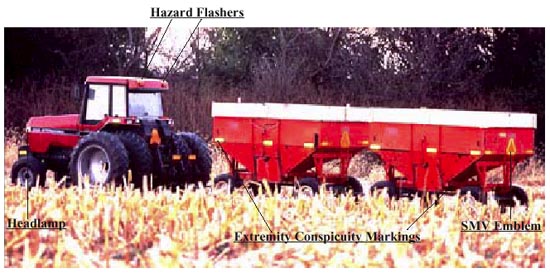
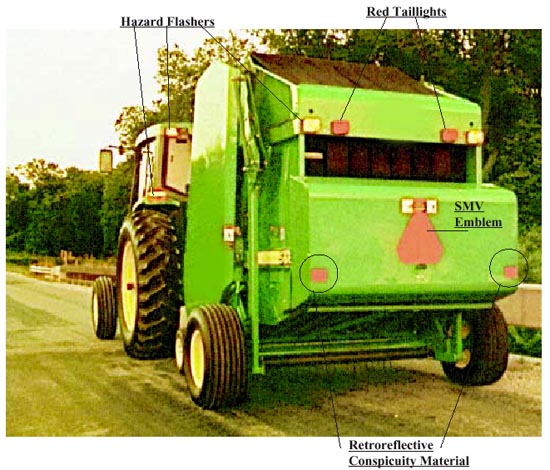
Table 1. ASAE recommendations and PA requirements for lighting
and marking of agricultural equipment on highways.
|
Title
|
ASAE
Recommendations
|
Pennsylvania
Requirements |
||
| # | Color | Mounting | ||
| Headlights | 2 | White | Red retro-reflective & red-orange fluorescent Yellow retro- reflective | Same as ASAE recommendation 1 |
| Taillights | 2 | Red | Symmetrically mounted to rear between 3. 3 ' &&10 ' high from 2 ' to 5 ' on left && right of machine center | 1 mounted at each side on rear 1 |
| Hazard Flashers | 2 or more | Amber | 3. 3 ' to 12 ' high & spaced as widely apart as practicable to be visible from front & rear | 2 if double-faced with amber to front &red to rear. 4 if single faced - amber on front corners & red on rear 1 |
| Turn Indicators | 2 | Amber & Red | Hazard flashers to also function as turn signals | Not required |
| SMV Emblem | 1 | Fluorescent orange for daylight & red retroreflective border for night | On rear center or rear left for maximum visibility of six hundred feet day or night; 2 ' to 10 ' above ground | All implements of husbandry designed to operate at 25 mph or less shall display the SMV on rear of vehicle at all times on highways |
| Reflectors which may be part of tail lamp lens or conspicuity material | 2 | Red on rear of machine | Size
to be 2 " wide by 4. 5 " long for machines  6. 7 ' wide. Size to increase to 2 " by 9 " for wider machines
 |
1 red reflex reflector or reflective tape at rear on each side &1 amber reflex reflector or reflective tape at front on each side with size of reflector to be 3 square inches or more 1 |
| 2 | Yellow on front of machine | |||
| Conspicuity material to better define size and to increase visibility | Red
retro- reflectors & fluorescent markers on rear corners
6 foot apart on rear. Front: change reflector color to
yellow 2 |
Red
retro- reflective & red-orange fluorescent Yellow retro- reflective |
Visible
to rear All mounted as horizontal & in line as practicable Visible to front Reflectors to be within 16 " of outside corners and fluorescent material within 25 " of outer corners. . |
SMV only |
| Rotating Beacons | Not Addressed | 2 yellow rotating beacons required if transporting perishable crops | ||
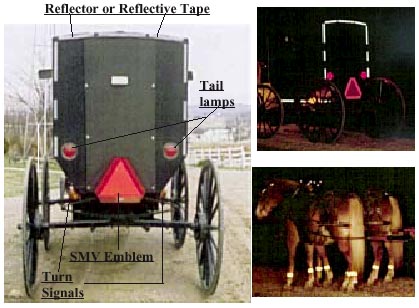
Typical Accidents:facts and figures
For years 1994 through 1996,Pennsylvania Department of Transportation
(PA DOT)figures for farm equipment crashes show:
Animal-Drawn
Vehicle Lighting & Safety Marking
|
| For more detailed information, refer to ASAE Standard 279. 10, Lighting and Marking of Agricultural Equipment on Highways and ASAE S276. 5, Slow-Moving Vehicle Identification Emblem. |
Publication #: E-41
The Pennsylvania State University is committed to the policy that all persons shall have equal access to programs,facilities,admission, and employment without regard to personal characteristics not related to ability,performance,or qualifications as determined by University policy or by state or federal authorities. It is the policy of the University to maintain an academic and work environment free of discrimination,including harassment. The Pennsylvania State University prohibits discrimination and harassment against any person because of age,ancestry color,disability or handicap,national origin,race,religious creed,sex,sexual orientation,or veteran status. Discrimination or harassment against faculty,staff,or students will not be tolerated at The Pennsylvania State University. Direct all inquiries regarding the nondiscrimination policy to the Affirmative Action Director,The Pennsylvania State University,201 Willard Building,University Park,PA 16802-2801,Tel 814-865-4700/V,814-863-1150/TTY.
Disclaimer and Reproduction Information: Information in NASD does not represent NIOSH policy. Information included in NASD appears by permission of the author and/or copyright holder. More



 3 square
inches on vehicle rear at each side if traveling roads
at night or during periods of reduced visibility. Do
the same with amber reflex reflectors or amber reflective
tape on the front of each side of the vehicle.
3 square
inches on vehicle rear at each side if traveling roads
at night or during periods of reduced visibility. Do
the same with amber reflex reflectors or amber reflective
tape on the front of each side of the vehicle.